
Bringing Project Management into your CRM is a sensible move — but it only works if approached correctly.
Many businesses struggle not because of the systems themselves, but because of how these systems are implemented and used. Here are some common CRM project management mistakes.
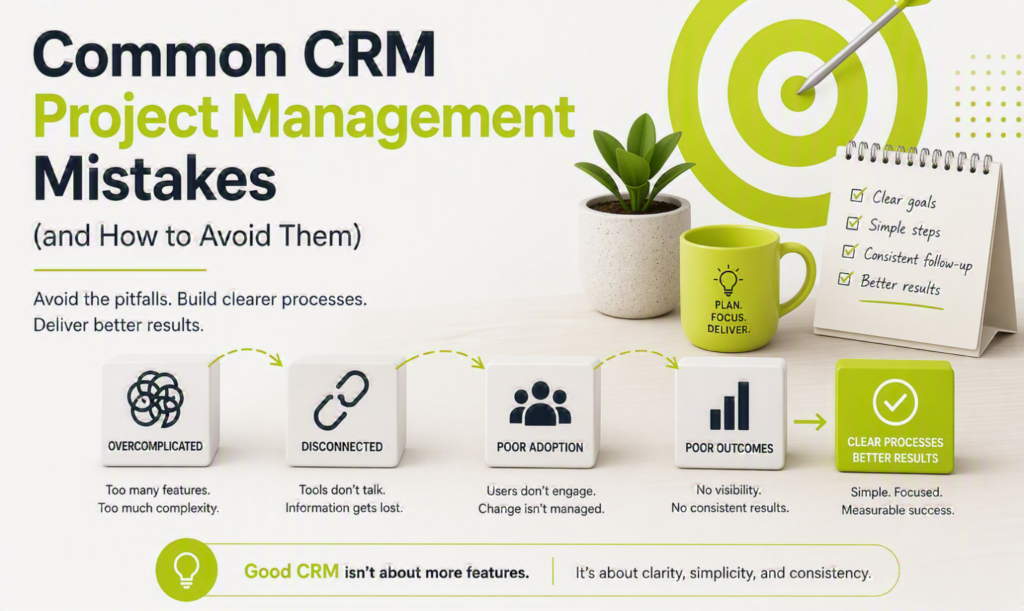
- Lack of clear goals leads to poor outcomes.
- Overcomplication reduces adoption.
- CRM should extend beyond sales into delivery.
- Ownership and simplicity are key to success.
- Fix processes before automating them.
Why CRM Project Management Fails
CRM project management doesn’t fail because the idea is wrong. It fails when businesses overcomplicate things, skip planning, or don’t bring their teams along with them.
More bluntly: most CRM failures are self-inflicted.
The system doesn’t break — the approach does.
Define Measurable Delivery Outcomes Before You Begin
If you’re using OpenCRM Projects to manage delivery, early on you need to define success in terms of how work gets delivered, not just how deals are won. Otherwise, you’ll end up with a system that tracks activity — but doesn’t improve performance.
From a project delivery perspective, your CRM should help you answer:
- Are projects being delivered on time?
- Are handovers from sales to delivery consistent?
- Do we have clear visibility of project status across the business?
Examples of measurable outcomes
- Reduce project delivery delays or missed deadlines
- Improve visibility of live project status across all clients
- Standardise handovers from sales into delivery
- Reduce time spent chasing updates or managing projects outside the system
If your Projects module becomes a place where work is recorded after the fact rather than managed in real time, you’ve already lost control. That’s not project management — that’s documentation.
Treating CRM as Just a Sales Tool
This is one of the most damaging — and surprisingly common — mistakes. Businesses implement CRM, get a basic pipeline working, and stop there. The system becomes a sales tracker rather than a business system.
What gets missed:
- Project delivery
- Account management
- Ongoing client communication
- Renewals and retention
The irony? The real value of CRM often comes after the sale.
If your CRM stops at “Won”, you’ve only built half a system.
Extend CRM usage into the full client lifecycle:
- Pre-sales → pipeline
- Post-sale → delivery/projects
- Ongoing → account management
Overcomplicating the Setup
This is where good intentions kill usability. Too many fields, pipelines and automations — and suddenly the CRM becomes slower than the thing it replaced.
What started as “let’s capture absolutely everything” turns into data nobody fills in, processes nobody follows, and reports nobody trusts.
Every extra field is a future point of friction. Every unnecessary automation is a future point of failure. Most teams don’t reject CRM — they reject badly designed CRM.
Start simple:
- One delivery process
- Essential fields
- Clear next-action logic
Poor User Adoption
Here’s the uncomfortable truth: if your team doesn’t use the CRM properly, your implementation will fail — regardless of how good the system is.
Low adoption usually isn’t about “resistance to change”. It’s caused by complexity, unclear value, and extra admin work. People avoid systems that make their job harder.
If your CRM feels like reporting rather than helping, adoption will collapse. And once adoption drops, the data becomes unreliable — once the data is unreliable, the system is dead.
- Involve users early (not after build)
- Keep workflows aligned to real work
- Provide ongoing, role-based support
Lack of Ownership
No ownership means slow failure. Without someone accountable, standards drift, data quality drops, and reports become inconsistent — and because it happens gradually, no one notices until the system becomes unusable.
A CRM without ownership will decay. Always.
Assign a clear owner responsible for data standards, process consistency, and ongoing improvements. Not IT. Not “everyone” — one accountable person, with the authority to make the required change.
Replicating Broken Processes
One of the fastest ways for your project management to fail in your CRM is to automate what already doesn’t work. CRM doesn’t fix bad processes — it accelerates them.
If your sales process is unclear, your CRM will reflect that. If your handover to delivery is messy, your CRM will systemise the mess.
If you haven’t simplified the process outside the CRM, don’t build it inside the CRM.
Before implementation:
- Map the process
- Remove unnecessary steps
- Define clear ownership
Disconnected Systems
A CRM that sits in isolation creates the illusion of control, not the reality. If it’s not connected to true project delivery, finance, and client communication tools, you still have silos — just better-labelled ones.
What happens: duplicate data, conflicting versions of truth, manual workarounds.
If your project team is still copying data between systems, your CRM isn’t solving the problem.
Either use a platform that connects the lifecycle, or invest properly in integrations. Partial visibility leads to poor decisions.
The Bigger Pattern (What’s Really Going Wrong)
When CRM projects fail, it’s usually not one mistake — it’s a chain reaction:
- No clear objective
- Overcomplicated design
- Poor user adoption
- Bad data
- Loss of trust
- System abandoned
“CRM doesn’t work for us.” — In reality, it’s the implementation that didn’t.
Final Thoughts
Success with CRM project management isn’t about adding more features. It’s about clarity, simplicity, and consistency.
Get those right, and the system will work. Get them wrong, and even the best CRM becomes an expensive admin tool that nobody trusts.

Ready to bring structure to your team?
See how OpenCRM can fit around the way your team already works.
Start your free trial