
CRM for Manufacturing: Bringing Sales, Production and Customer Data Together
Manufacturing businesses often have information spread across multiple systems, even as digital transformation in manufacturing reshapes how teams work.
Customer enquiries sit in one place, quotations in another, production schedules somewhere else, and accounting data in a separate package entirely.
Whilst this approach can work for a time, growth often exposes the gaps. Teams spend more time chasing information, updating spreadsheets and checking progress than they do serving customers.
A CRM designed for manufacturing helps bring those moving parts together, giving everyone access to the same information and reducing the risk of costly mistakes.
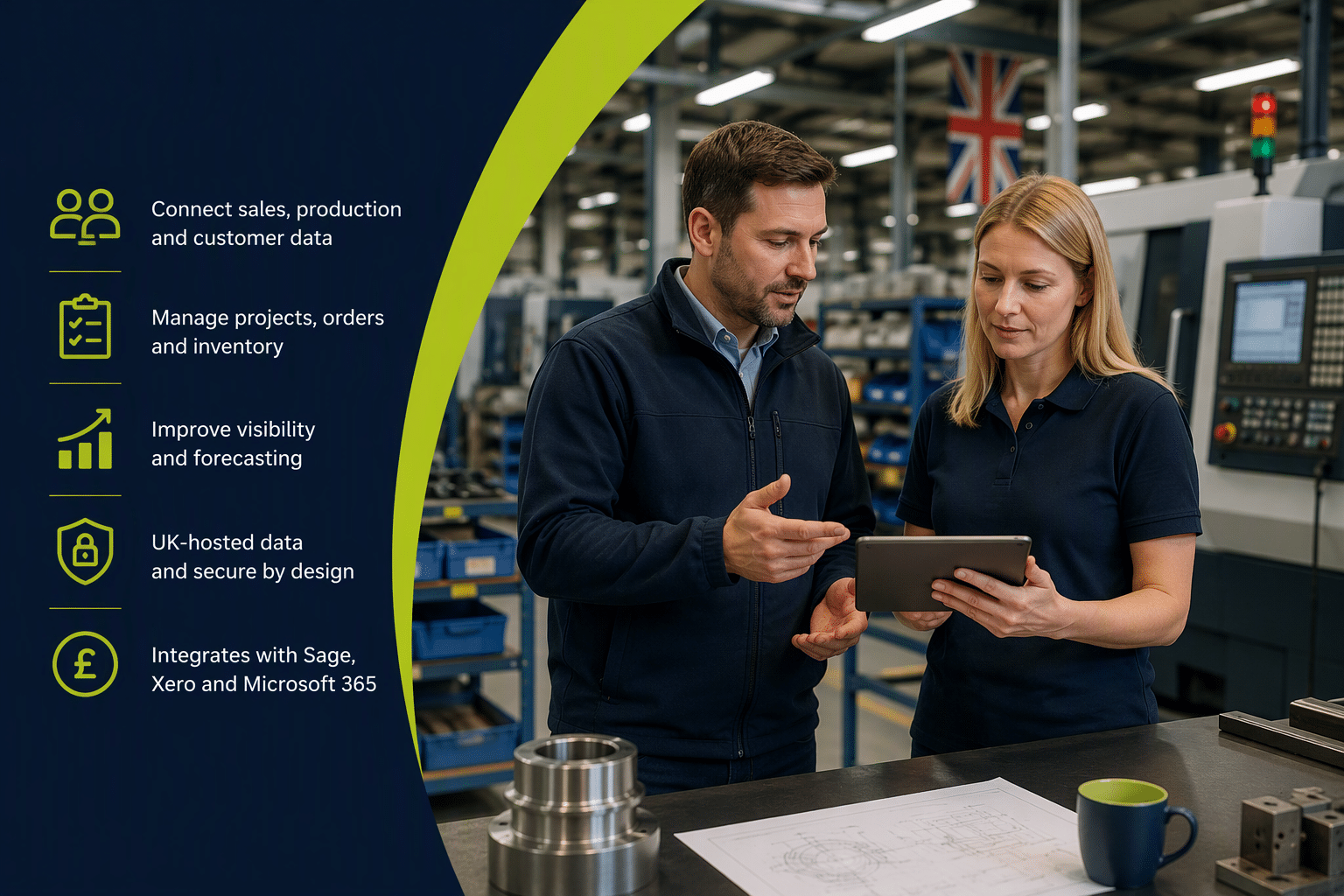
- Manufacturers need visibility beyond the sales pipeline — across quoting, production, delivery and support.
- Disconnected spreadsheets and systems slow growth and make planning harder.
- Shared visibility between sales and production leads to more realistic delivery expectations.
- Project management tools help track bespoke orders from enquiry through to delivery.
- Integration with Sage, Xero and Microsoft 365 cuts duplicate data entry.
- UK-hosted data brings extra reassurance for governance and supplier due diligence.
Why Manufacturing Businesses Need More Than a Standard CRM
For many manufacturers, a customer relationship is only the beginning of the process.
After a sale comes quoting, planning, purchasing, production, delivery, invoicing and ongoing support. Each stage relies on accurate information being available to the right people at the right time.
A generic CRM may manage contacts and sales opportunities well, but manufacturers often need visibility far beyond the sales pipeline.
The real value comes from connecting customer information with operational processes, allowing teams to work from a single source of truth.
Common Challenges Manufacturers Face
As the wider UK manufacturing sector grows, a number of familiar issues tend to emerge:
Multiple versions of spreadsheets
Difficulty tracking order status
Limited visibility between sales and production
Delays caused by manual data entry
Stock and inventory data held separately from customer records
Time spent chasing updates across departments
None of these problems are unusual, but together they can slow growth and make planning more difficult.
Connecting Sales and Production
One of the biggest advantages of a manufacturing CRM is improved communication between commercial and operational teams — connecting sales management with the factory floor.
When sales teams can see production capacity and project progress, they can provide customers with realistic delivery expectations.
Likewise, production teams gain visibility into upcoming opportunities and forecast demand more effectively.
This helps reduce surprises, improves planning and creates a better experience for customers.
Managing Projects and Orders More Effectively
Many manufacturers deliver bespoke products, customer-specific projects or made-to-order solutions.
In these environments, managing progress through email chains and spreadsheets quickly becomes difficult. A CRM that includes project management capabilities can help teams:
- Track project milestones
- Monitor deadlines
- Assign responsibilities
- Record customer communications
- Manage documentation
- Maintain visibility across the entire delivery process
Having this information connected to customer records means everyone involved can quickly understand the status of an order without searching across multiple systems.
Inventory and Operational Visibility
Stock shortages and over-ordering can both be expensive.
When forecasting, sales activity and inventory data are disconnected, it becomes harder to make informed purchasing decisions.
By bringing these areas together with inventory management, manufacturers can gain a clearer picture of future demand and current commitments. Better visibility helps reduce unnecessary stock holding while ensuring critical components are available when needed.
Integration with Sage, Xero and Microsoft 365
Most manufacturers already rely on several business systems. A CRM should complement those investments through CRM integrations rather than replace them, including accounting software integration.
The less time employees spend manually transferring information between systems, the more time they can spend on productive work.
Data Security and UK Hosting
Manufacturers often store valuable customer information, technical documentation and commercially sensitive data. For many businesses, understanding where that information is stored is becoming increasingly important.
Choosing a CRM with UK-hosted infrastructure can provide additional reassurance around data residency, governance and compliance requirements. It also makes supplier due diligence conversations simpler when customers ask where their information is stored and protected.
Why Manufacturers Choose OpenCRM
OpenCRM helps manufacturing businesses manage customer relationships, projects, support requests and operational processes from a single platform.
Customers typically tell us they value:
Most importantly, they gain visibility across the entire customer journey, helping sales, operations and management teams work more effectively together.
The manufacturing CRM, at a glance
See how sales, production, projects and inventory connect in one infographic.
Choosing the Right CRM for Manufacturing
The best CRM for a manufacturing business is one that reflects how the organisation actually works.
Rather than focusing solely on sales opportunities, manufacturers often need visibility across projects, production, inventory, finance and customer service.
Connecting these functions creates a more efficient operation, improves communication across teams and provides a stronger foundation for growth.
If you’re evaluating CRM options for your manufacturing business, focus on the practical requirements that matter most to your team: visibility, integration, operational efficiency and long-term support.
A CRM should help simplify the way your business operates, not add another layer of complexity.
Frequently Asked Questions
Why do manufacturers need more than a standard CRM?
A generic CRM manages contacts and opportunities well, but manufacturers need visibility across quoting, production, delivery and support — connecting customer information with operational processes.
Can OpenCRM manage bespoke projects and made-to-order work?
Yes — OpenCRM’s project management tools help track milestones, deadlines, responsibilities and documentation, all connected to the customer record.
Does OpenCRM connect with Sage and Xero?
Yes — OpenCRM integrates directly with Sage, Xero, Microsoft 365, Outlook and SharePoint to reduce duplicate data entry.
Is manufacturing data hosted in the UK?
OpenCRM’s infrastructure keeps your data hosted within the United Kingdom, supporting governance and supplier due-diligence requirements.
Can OpenCRM improve visibility between sales and production?
Yes — when sales teams can see production capacity and progress, they can set realistic delivery expectations, and production teams gain visibility into upcoming demand.

See OpenCRM built for manufacturing
We’d be happy to show you how OpenCRM connects sales, production and customer data in one platform.
Book a live demonstration