
At its core, OpenCRM connects your entire client journey — from first enquiry through to final delivery and invoicing.
Instead of treating sales and project management as separate activities, it creates a continuous workflow that keeps everyone aligned. That shift alone removes many of the inefficiencies that slow businesses down.
For many organisations, the biggest challenge isn’t winning work — it’s delivering it consistently. OpenCRM addresses this by ensuring that the same system used to manage opportunities is also used to run projects, meaning nothing gets lost or reinterpreted along the way.
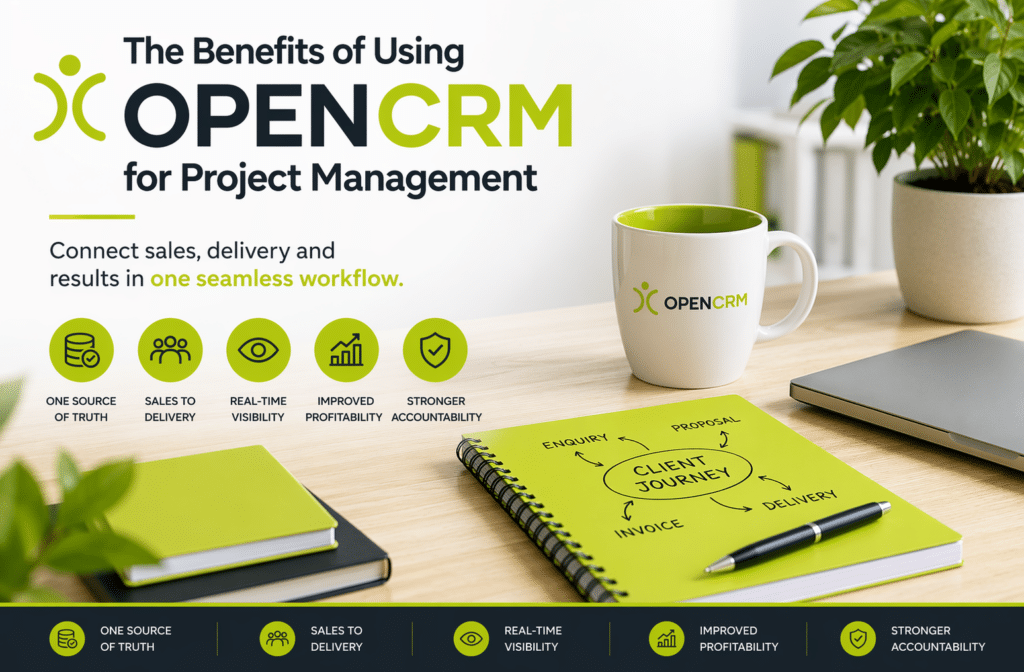
- No more scrambling for information at project start — everything is already there.
- Sales and delivery operate as one process, not two disconnected silos.
- Teams work from the same data, reducing errors and second-guessing.
- Managers see what’s happening in real time, not retrospectively.
- Fewer tools, fewer subscriptions, less friction.
- Accountability becomes clearer because everything is visible and tracked.
- Profitability improves because effort and outcomes are connected.
A Single Source of Truth Across Your Business
One of the biggest advantages is being able to pull everything together. All project data, customer communications, and activities are in one place — no need to jump between systems or rely on incomplete information.
In practical terms, this means that emails, notes, call logs, documents, and timelines are all directly linked to the customer and the project. Anyone involved can instantly see the full history without needing to ask around or search multiple tools. This removes the typical “handover gap” where details are lost as a deal moves into delivery.
- Better informed teams
- Fewer misunderstandings
- More consistent project outcomes
Seamless Sales-to-Delivery Handover
When a deal is won, it becomes a project straightaway — with all previous context included. There’s no duplication, no re-keying, and no reliance on memory. Everything agreed upon during the sales process — scope, pricing, expectations, and key contacts — is already available to the delivery team.
This is particularly valuable for growing businesses, where increased volume often leads to less formal or inconsistent handovers. OpenCRM ensures that every project starts from a complete and accurate foundation.
- Faster project setup
- Improved client confidence
- Reduced internal friction
Real-Time Visibility and Control
OpenCRM gives you a live view of projects across your business. Progress, timelines, activities, and communication are all visible in one place, allowing managers to stay informed without constant reporting or chasing updates.
Rather than relying on periodic status meetings or spreadsheets, you can see what’s happening as it happens — which makes it easier to intervene early if things start to drift. When actions occur, the system automatically updates key players.
- Better decision-making
- Early identification of issues
- Stronger operational control
Reduced Tool Fatigue
Many businesses rely on multiple tools — CRM, project software, email tracking, invoicing systems. Each system introduces complexity, cost, and points of failure. Integrations can help, but they rarely remove all friction and often require ongoing maintenance.
OpenCRM removes that complexity by bringing everything together into a single platform. Teams don’t have to learn multiple systems or manage separate workflows, which improves adoption and reduces resistance to change.
- Fewer subscriptions
- Less integration overhead
- Simpler training and onboarding
Stronger Communication and Accountability
With all emails, activities, and documents linked to each project, everyone works from the same information. There’s no ambiguity about what’s been said, what’s been agreed, or what needs to happen next. Tasks can be clearly assigned, tracked, and reviewed within the same system.
This also creates a natural audit trail — useful for both internal management and client transparency.
- Clear task ownership
- Fewer missed actions
- Better client communication
Improved Project Profitability
When time, activity, and invoicing are connected, you get a true picture of project performance. Instead of relying on rough estimates or disconnected reports, you can see exactly where time is being spent and how it compares to what was sold. This makes it easier to identify scope creep, inefficiencies, or under-priced work.
Over time, this data becomes invaluable for improving future estimates and pricing strategies.
- More accurate pricing
- Better forecasting
- Improved profitability
Final Thoughts
Using OpenCRM for project management isn’t just about organising work — it’s about improving how your business delivers value. Having a strategy is important, but having the tool to deliver your vision deserves dedicated focus.
By connecting sales, delivery, and financial outcomes in one system, you create a smoother, more predictable way of working. Teams spend less time chasing information and more time focusing on delivery, while clients benefit from a more consistent and professional experience.

Ready to bring structure to your team?
See how OpenCRM can fit around the way your team already works.
Start your free trial