
Know what happened. Know what you advised. Know what happens next.
CRM for health and safety businesses starts with one thing: a clear history of every client. For a health and safety consultancy, that matters.
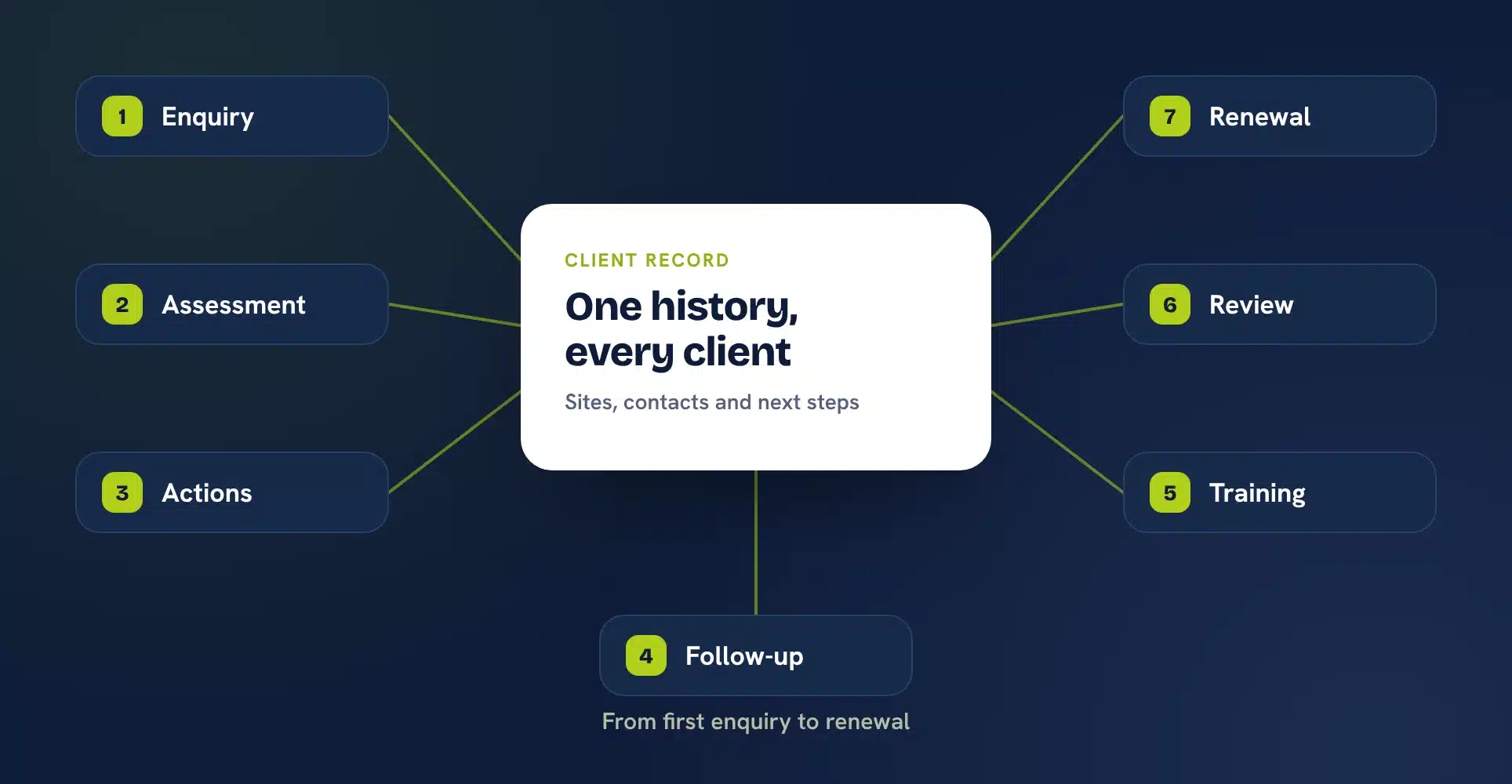
What happened? What did you advise? What actions were agreed? Has anything been followed up? When is the next assessment or review due?
Those questions are straightforward when you’re dealing with a handful of clients. Across dozens or hundreds of clients, sites, assessments, training courses and ongoing support agreements, keeping the complete picture together becomes much harder.
The problem usually isn’t a lack of systems
Most established health and safety businesses already have systems. The problem is often that they have quite a lot of them. Client details sit in one place, reports in folders, training records somewhere else, actions on spreadsheets and important conversations in email.
None of that is wrong in itself. The difficulty comes when you need the whole picture. Can you answer these quickly?
The more fragmented the information, the more effort it takes just to stay on top of it.
How CRM helps health and safety businesses build long-term clients
Many organisations use external health and safety consultants and advisers to provide expertise they don’t have in-house. Health and safety businesses aren’t only managing compliance activity. They’re selling a mix of services, and much of the value sits in the work that follows the first job.
That makes the relationship commercial as well as operational. An enquiry might start with a single risk assessment, then develop into reviews, training, additional sites and other services. Whether it does often depends on how well the business follows up.
Holding that history together lets you see the relationship rather than a string of separate transactions. You can see which enquiries are still open, which assessments led to further work and which long-standing clients haven’t heard from you for a while.
That’s where CRM can add something that many specialist systems aren’t primarily designed for: helping turn enquiries into clients, and clients into longer relationships.
Complexity builds as you grow
Behind each of those stages sits a lot of information. A fairly typical ongoing client relationship can include:
That isn’t one simple customer record. It’s an ongoing relationship made up of people, activities, obligations, documents and dates.
With a small number of clients, experienced people carry a lot of this in their heads. That works. Until it doesn’t. A new consultant joins. Someone goes on holiday. A customer opens another location. You expand into training.
Dave normally handles the annual review.
Sarah changed sites, but only some of the team know.
Renewal dates live on a personal calendar.
A colleague is on holiday and nobody is quite sure what was agreed.
The review is a task, assigned and dated.
The site and contact changes sit on the client record.
Renewal dates are recorded where everyone can see them.
Anyone can pick up the conversation from the history.
Don’t just store information. Use it.
A good system shouldn’t become another filing cabinet. Where the dates and next steps are recorded, information can trigger activity.
A CRM works from the dates and processes you set up. It isn’t a certification or compliance platform, and it doesn’t need to be. The useful question is a simple one.
What does your team currently have to remember that your system could remember for them?
The same information gives you a better view of the business
Bringing it together also changes what you can report on. Instead of only knowing how many clients you have, you can ask more useful questions:
The answers often already exist somewhere in the business. The challenge is bringing them together.
CRM doesn’t replace specialist health and safety expertise
This distinction matters. A CRM isn’t a substitute for specialist risk assessment tools, compliance expertise or professional health and safety software where you need them. Nor should you abandon specialist applications just to put everything in one system.
Specialist systems
Carry on doing specialist jobs: risk assessments, compliance records and the technical work your expertise is built on.
Your CRM
Sits around them and provides the joined-up client picture. Who is the client? Which sites and people are involved? What have we done? What was agreed? What happens next?
What might that look like in practice?
At OpenCRM, we think of CRM as much more than a sales pipeline. It brings sales, customer records, projects, activities, support and marketing together around the same underlying information, rather than leaving each team to maintain its own version of the customer relationship.
For a health and safety business, that could mean building a structure around:
Organisations
The businesses you advise.
Locations
The individual sites you support.
Contacts
Managers, responsible persons, delegates and other stakeholders.
Activities
Calls, visits, consultations, reviews and follow-ups.
Projects and service delivery
Larger pieces of consultancy or implementation work.
Documents
Reports and supporting information attached to the right client records.
Products and services
The consultancy, assessments, training or recurring services you provide.
Marketing and follow-up
Keeping in touch with prospects and existing clients without a separate database.
The aim isn’t to push every health and safety company into the same workflow. It’s almost the opposite. Your system should reflect how your business actually works.
Perhaps that’s the real test
Health and safety businesses help their clients put good processes in place to manage risk. There’s an interesting parallel in managing the consultancy itself.
As a business grows, informal processes eventually need structure. Information needs an owner. Important dates need recording. Actions need following up. And everyone needs to know what’s happening without relying on the one person who happens to remember.
So a useful question isn’t “Do we need a CRM?” It’s this:
If one of our team opened a client record right now, could they understand the entire relationship and know what needs to happen next?
If the answer involves opening three systems, searching an inbox and asking somebody else, there’s probably room for improvement.
Frequently asked questions
Does a health and safety business need a CRM?
Not on day one. But once enquiries, client details, assessments, actions, training and review dates are spread across several systems, a CRM can bring the client picture together so your team can see the whole relationship and what needs to happen next.
Can a CRM replace specialist health and safety software?
No, and it shouldn’t try to. Specialist risk assessment and compliance tools do specialist jobs. A CRM sits around them, holding the enquiry, client, site, contact and activity history that connects the commercial and operational relationship.
What information should a health and safety business keep in its CRM?
Typically organisations, sites, contacts, enquiries and quotes, calls, visits and meeting notes, follow-up tasks, review and renewal dates, the services each client receives, and the reports and documents that relate to them.
Does a CRM work for fire safety and other related safety services?
Yes. Many safety businesses combine consultancy and risk assessment with inspections, maintenance, installation or training. A CRM can be structured around however your services are delivered, so each client relationship is held in one place.
Next steps
OpenCRM brings sales, customer management, support, projects, activities, products and marketing together in one system, with UK-hosted data and UK-based support.
If you run a health and safety business and want to see how your existing processes could translate into CRM, we’ll build the picture around your workflow rather than ours.

See how OpenCRM could work for your health and safety business
Show us how you currently manage enquiries, clients, assessments, training and follow-ups, and we’ll show you how those processes could work together in OpenCRM.
Book a demo