
Configurable CRM Isn’t the Same as a CRM Built Around You
Almost every CRM claims to be customisable. Far fewer can be shaped around the way your business actually works, and you usually only notice the difference once you’re living with it.
Every CRM demo has the same moment. Someone asks, “Can it do that?” and the answer comes back: “Yes, it’s fully configurable.” Custom fields, drag-and-drop pipelines, a workflow builder, a marketplace of add-ons. It sounds reassuring, and it’s usually true.
But configurable describes what the software lets you change. Built around you describes whether the result actually matches how your business operates. For many organisations, the two are close enough. For others, it’s a different story. That includes businesses with specialist processes, compliance obligations, or a way of working that is itself their competitive edge. For them, the gap between the two is where the frustration lives.
We see both sides every day, because OpenCRM delivers all three: off-the-shelf, configured and bespoke, on the same platform. So this isn’t an argument that everyone needs something custom. It’s about knowing which level you need today, and making sure you’re not locked out of the others tomorrow.
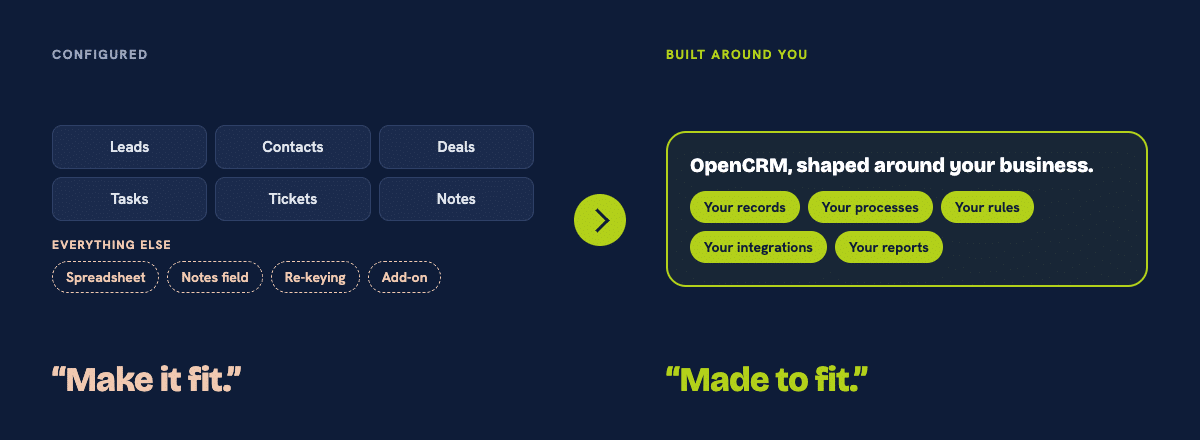
Configuration asks: how much of your business can we fit into this software?
Built around you asks: what does the software need to be for your business?
- “Configurable” usually means changing settings inside a fixed design: fields, stages, layouts and simple rules.
- Businesses with specialist processes often hit the limits of configuration within the first year.
- When the software can’t change, people change instead, through spreadsheets, workarounds and manual steps.
- Workarounds feel free because no one invoices for them. They’re paid for in staff time instead.
- You don’t have to decide on day one. The right platform lets you start simple and grow into a tailored system without changing CRM.
- Tailored doesn’t have to mean starting from scratch. Building on a proven platform keeps the fit and reduces the risk.
- Off-the-shelf is the right answer for plenty of organisations. The important thing is knowing which side of the line you’re on.
Three Levels of Fit
It helps to separate three things that are often sold under the same word.
Standard modules and standard processes. Quick to start, and a good fit if your processes are standard too.
Rename fields, add stages, build simple rules. The design underneath stays exactly the same.
New record types, custom logic, bespoke screens and integrations, designed around your processes.
Most CRM products sit comfortably in the first two, and the marketing tends to blur the line into the third. That’s where expectations and reality start to part company. OpenCRM is designed to cover all three, and to let you move between them.
Where most businesses actually sit
In practice, most OpenCRM customers are somewhere in the middle. They use the standard modules, but with their own terminology, workflows, permissions, dashboards, reports and integrations. They aren’t commissioning bespoke development every month, and they aren’t using the CRM exactly as it arrived either. They simply want a system that reflects how their business works.
That middle ground is often overlooked, because it’s less eye-catching than a custom build. But it’s where a well-set-up CRM earns its keep, and it’s usually a far better starting point than jumping straight to bespoke.
The Good News: You Don’t Have to Start at Level Three
One of the biggest misconceptions about tailored CRM is that you need to begin with a major development project. Research published in Harvard Business Review found the opposite: the most successful CRM users started with a focused project, then used it as a springboard for solving further problems.
In reality, many organisations start with a largely standard CRM. As the business grows, new requirements emerge. Additional workflows are introduced. Integrations become important. Processes evolve. What began as an off-the-shelf CRM gradually becomes something more specialised.
The important part is that the underlying platform stays the same. You don’t replace the CRM. You build on it.
Contacts, pipeline, email and support, used largely as it comes.
Custom fields, workflows and reports as the team finds its way of working.
Connected to accounts, operations and the other systems the business relies on.
Shaped around the processes that make the business what it is.
That means today’s requirements don’t have to limit tomorrow’s possibilities. A CRM that works perfectly well out of the box can also become one tailored around the way your organisation operates, when the time is right, and not before.
The real risk isn’t choosing the wrong level of fit on day one.
It’s choosing a CRM that leads to a dead end.
Where Configuration Runs Out
Configuration is powerful, but it has limits, and they tend to show up in the same places.
You can add a field for almost anything. Making the system act on it is a different matter: calculating, validating and triggering the right next step.
Leads, contacts, deals and tickets. But what if your business revolves around properties, events, shifts, assets or licences? Squeezing them into a “deal” works until it doesn’t.
Simple “if this, then that” rules cope well with straight lines. Real processes have exceptions, approvals, dependencies and deadlines.
A marketplace connector syncs the fields it was designed to sync. Your industry system, or the way you need data to flow, may not be on the list.
None of this is a failing of the software. It was designed for the typical customer. The question is whether you are one.
When the Software Can’t Change, People Do
If a system can’t adapt to the process, the process gets adapted to the system instead. It rarely happens in one decision. It creeps in through small compromises that each sound sensible at the time:
Each one is small. Together, they mean the CRM holds part of the picture while the rest lives in people’s heads, inboxes and side files. Reporting becomes unreliable, onboarding new staff gets harder, and the gap between what the system says and what’s really happening widens a little every month. Left alone, it’s the fastest route to CRM drift.
The same information entered in two or three places, with every copy a chance for a mistake.
Dashboards that need correcting by hand before anyone is willing to act on them.
When a key person is off, or leaves, part of the process goes with them.
If the way you work is what sets you apart, forcing it into a generic template quietly takes that away.
Nobody sends you an invoice for a workaround. You pay for it anyway, one re-typed record at a time.
Signs You’ve Outgrown Configuration
None of these on its own means you need something different. But the more of them that sound familiar, the more likely it is that the problem isn’t your settings.
If several of these apply, it’s worth asking whether another off-the-shelf CRM will genuinely solve the problem, or simply move the limits somewhere else.
Avoiding CRM Dead Ends
Most businesses that switch CRM aren’t unhappy with the idea of CRM. They’ve hit a dead end: the point where the system can’t go any further, and the only way forward is to leave it behind and start again.
Starting again is rarely just a software decision. It usually means:
And too often, the new system is chosen for the same reasons as the old one, so the business reaches the same dead end a few years later with different software. The question worth asking before you buy isn’t just “does it do what we need now?” It’s “what happens when we need more?”
The most expensive CRM decision is the one you have to make twice.
Buy once. Evolve continually.
What “Built Around You” Looks Like in Practice
Two sectors we work with show where the line falls. The details are different, but the pattern is the same: a standard CRM could store the information, but it couldn’t run the business.
High-value sales run on relationships and properties, not a simple deal pipeline.
Contacts, companies and a sales pipeline.
Detailed property records linked to owners, buyers, lenders and other agents, with consultant schedules, viewings and appointments tied to each one, plus a discreet, complete history of every high-net-worth client relationship.
Every event is a project, a rota and a compliance check at once.
Deals, tasks and a shared calendar.
Events linked to venues, clients and staff deployments, officers matched to each role by skills and licences, training tracked with expiry alerts, and timesheets, quoting, scheduling and invoicing that follow how each event is actually run.
In both cases, the answer wasn’t a different off-the-shelf product. It was the same OpenCRM platform, shaped around a very different business.

Don’t just take our word for it
Read how other organisations use OpenCRM, from out-of-the-box implementations to bespoke development.
Find out more →Doesn’t Bespoke Mean Expensive and Risky?
It’s a fair concern. Most buyers have heard stories of custom systems that ran over budget, depended on one developer and became impossible to maintain. But those stories are almost always about building from scratch, and that’s not the only way to get a system that fits.
Built from scratch
- Every screen, rule and security layer written new
- A long wait before anything is usable
- Knowledge often concentrated in a few developers
- Upgrades and long-term support can become your problem
Occasionally justified for truly unique requirements, but rarely the best value.
Built on a proven platform
- Core CRM, security, hosting and mobile already in place
- Tailoring focused only on what makes you different
- Usable early, then extended over time
- Maintained by the team that owns the platform
Tailored where it matters, standard where it doesn’t.
Bespoke shouldn’t mean starting from zero.
It should mean starting from something proven, and changing only what needs to change.
OpenCRM: A Platform Built to Be Shaped
For more than twenty years, OpenCRM has been used in three ways: as a ready-to-use CRM, as a configurable CRM, and as a framework for building something more specialised.
Many customers never move beyond the first stage. The standard product covers sales, marketing, helpdesk, projects, orders and more, and it does the job well. Others start there and gradually evolve their system over time, and many of our longest-standing relationships are with organisations whose needs eventually went further than any standard CRM could.
The important point is that they are all using the same platform. We can take a customer from standard CRM to a fully tailored one without changing platform, supplier or team.
The settings menu isn’t the boundary
Most CRMs can only be tailored as far as their settings allow. OpenCRM is our own platform, so that limit doesn’t apply in the same way. If a business needs a new type of record, a process with its own logic, or a link to an industry system nobody else connects to, we can build it. And if that means extending the core product, that’s an option too.
The people who design it stay with it
Process mapping, solution design, development and day-to-day support all sit with our own staff in North Yorkshire. When you ask for a change in year six, you’re talking to people who can see what was built in year one and the reasons behind it. For a system that grows over many years, that history is worth more than any single feature. It’s also one of the practical advantages of choosing a UK-based CRM provider.
Built to evolve, not to be replaced
Businesses change, and a tailored CRM should change with them without a rebuild every few years. It’s a point Gartner makes in its research with over 2,000 CIOs: business systems now need to be built for continuous change, favouring adaptability over fixed, one-off design. Because we manage both the platform and the custom work, updates and bespoke development are planned together rather than colliding. Our CRM project approach is designed around that: discovery first, then design, build and continual refinement.
OpenCRM isn’t just a CRM you configure. It’s a platform we can shape, and a team that stays with it.
Plenty of customers will never need bespoke work, and we’d rather say so up front than build something you don’t need. Twenty-odd years of CRM projects have taught us that the best systems are the ones that start small and earn every addition.
Is Off-the-Shelf Enough for You?
A rough rule of thumb:
- Your processes are close to the industry norm
- You mainly need contacts, pipeline and email
- You’re happy to adapt to how the software works
- Your requirements are unlikely to change much
- Your core records aren’t contacts or deals
- You have specialist compliance or audit needs
- Your process is part of your competitive edge
- You’ve already outgrown one CRM
Questions to Ask Before You Decide
Demos are designed to impress. These questions are designed to find the edges.
Not the standard demo data. Our records, our steps, our exceptions.
Is the answer a workaround, an add-on, or new development?
This one question separates configurable from genuinely flexible.
Or can the same system, and the same data, simply grow with us?
Ask for an example of one that has, and how it was handled.
A real example says more than a feature list.
Make It Fit, or Made to Fit
“Make it fit.”
“Made to fit.”
Configurable software is a good thing, and for many businesses it’s all they’ll ever need. But configuration has limits, and when a business runs into them, the cost shows up as workarounds, spreadsheets and people quietly doing the job the system should be doing.
That’s the thread running through everything we do. Off-the-shelf, configured or bespoke, OpenCRM delivers all three on one platform, with one team.
The best position to be in is one where you never have to choose. Start simple if that’s what you need. Grow when you need more. Tailor when the business demands it. And never reach the point where you have to throw everything away and start again.
The real question isn’t whether a CRM can be configured. It’s whether your business should be fitting around your CRM, or your CRM around your business.
For a side-by-side view of where OpenCRM sits against other CRMs, see our CRM comparisons.
Frequently Asked Questions
What’s the difference between a configurable CRM and a CRM built around your business?
A configurable CRM lets you change settings within a fixed design: fields, pipeline stages, layouts and simple rules. A CRM built around your business starts from how you actually operate and shapes the system to match, which can include new record types, custom logic, bespoke screens and integrations with industry-specific systems.
Is a tailored CRM more expensive than off-the-shelf?
The up-front cost is usually higher than a standard subscription. But building on an existing platform rather than from scratch keeps that cost focused on what makes your business different. It’s also worth weighing against the hidden cost of an ill-fitting system: duplicate data entry, spreadsheets, manual reporting and add-ons bought to fill gaps.
How do I know if I’ve outgrown off-the-shelf CRM?
Common signs include key processes living outside the CRM, your core business records not fitting the standard contact or deal structure, reports needing manual correction, compliance tasks being handled by hand, and a growing list of things the system can’t do. If several of these apply, the issue is usually fit rather than settings.
Can a tailored CRM still be updated and supported?
Yes, provided the people who maintain the platform are also the people who build the tailoring. That way, each platform update is planned with the custom work in mind, rather than discovered afterwards to have broken it.
Do we need to start with a bespoke CRM project?
No. Many organisations start with a largely standard CRM and add configuration, integrations and tailored development as their needs grow. On a platform like OpenCRM, that happens on the same system, with the same data and the same team, so there’s no need to replace the CRM when requirements change.
Can OpenCRM be used as a standard CRM?
Yes. Many customers use OpenCRM largely as it comes, with sales, marketing, helpdesk, project and order management included. For organisations with more specialist needs, the same platform can be shaped around their processes by OpenCRM’s in-house UK team.

Start where you are. Grow without starting again.
Book a Discovery call, and bring your processes, your workarounds and your “it can’t do that” list.
Book Discovery call