
20 Things We’ve Learned from Over 20 Years of CRM Implementations
Not twenty tips. Twenty observations from more than twenty years of real implementations — including the ones that taught us the hard way.
We’ve been building and implementing CRM for over twenty years now. In that time we’ve sat in a lot of rooms, listened to a lot of requirements, and watched plenty of projects go brilliantly. We’ve also watched a few go sideways, which is usually where the more useful lessons come from.
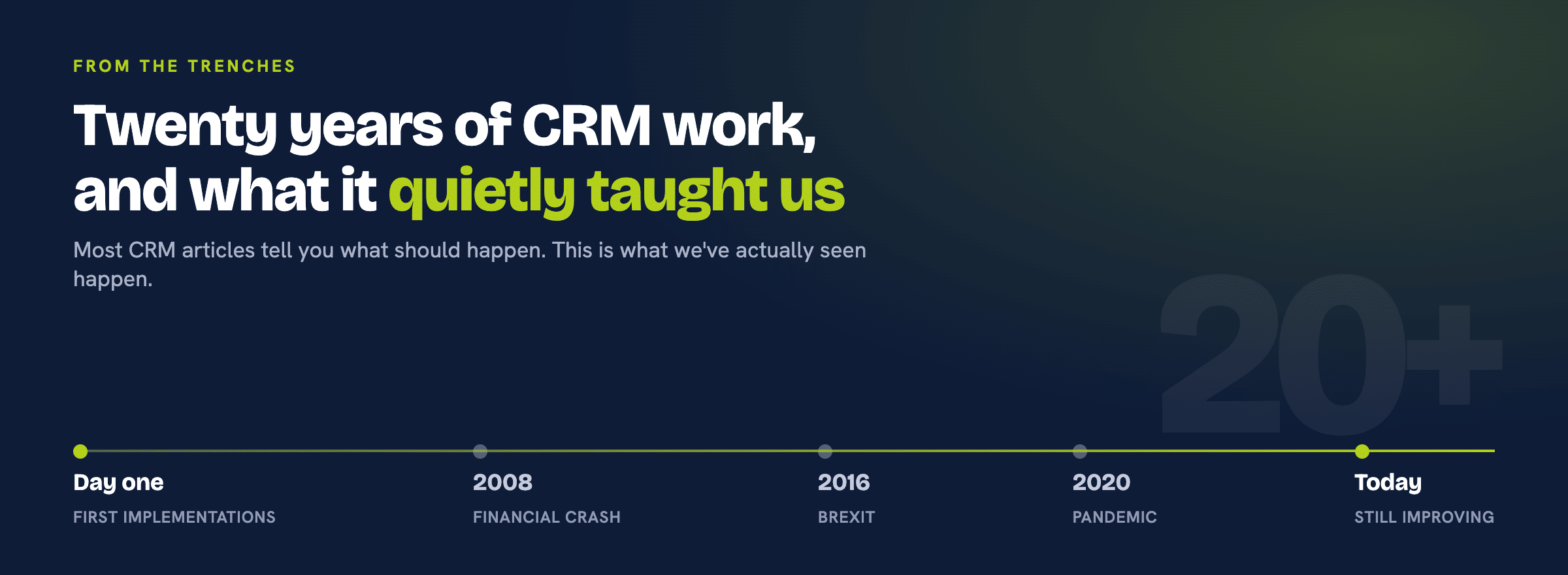
Most CRM articles tell you what should happen. This one is about what over 20 years of CRM has taught us — what we’ve actually seen happen. Some of it is obvious in hindsight. Some of it we’d have argued with ourselves about fifteen years ago. All of it comes from doing the work rather than reading about it.
After more than 20 years, we’ve learned that CRM success has surprisingly little to do with CRM software. The software matters — but people, processes and adoption matter far more.
- The best CRM system is the one people actually use — everything else is secondary.
- Every field has a cost, and customers rarely complain about having too few.
- Reporting problems are almost always data entry problems wearing a disguise.
- Most CRM projects have too many requirements, and a long list feels like diligence.
- Good and live beats perfect and six months late.
- A CRM project is never finished, and the best customers are fine with that.
People, Not Software
If we had to point at one thing that separates a CRM that works from a CRM that gathers dust, it wouldn’t be a feature. It would be whether the people using it every day feel like it’s helping them or auditing them.
The best CRM system is the one people actually use
We’ve seen beautifully configured systems, built to an exhaustive specification, quietly abandoned within six months. We’ve also seen deliberately simple setups become the single most important system in a business. The difference was never the configuration. It was whether the people expected to use it were involved in shaping it.
We’re not the only ones to notice: the research on change management and project success consistently finds that projects treating the people side seriously are several times more likely to hit their objectives. That matches what we see, and it has nothing to do with which CRM you buy.
Put a real user in the room from day one, not just the person signing the contract.
CRM is not a magic fix for a broken process
A CRM amplifies whatever process you already have. If your handover from sales to delivery is vague, automating it just makes the vagueness arrive faster and more reliably. One mistake that appears repeatedly is buying software in the hope it will decide how the business should work.
Agree the process first, even roughly. Then automate it.
The CRM isn’t usually the system people are complaining about
“The CRM is a nightmare” is often shorthand for something else entirely — an approval step nobody understands, a pricing rule that changes monthly, or two teams who disagree about who owns a customer. The CRM is simply where those disagreements become visible.
When someone blames the system, ask what they were trying to do when it went wrong.
If a user can’t see what’s in it for them, they won’t fill it in
Salespeople are not naturally opposed to entering data. They’re opposed to entering data that only ever travels upwards. The moment the system starts giving something back — a reminder that saved a deal, a quote produced in two minutes instead of twenty — the resistance tends to disappear on its own.
Build one thing that makes each user’s own day easier before you build the management report.
Training once is not training
Most training happens before anyone has any real questions. Two weeks later, when people have actually tried to do their job in the system, is when the useful questions arrive — and by then the training session is long over. The most successful customers tend to book a second session deliberately, a month after go-live.
Plan the follow-up session at the same time as the first one.
We’ve never had a customer tell us their team adopted the system because the software was clever. They tell us it was because someone senior used it too.

Don’t just take our word for it
Click to read how other companies have benefited from using OpenCRM — from out-of-the-box implementations to bespoke development.
Find out more →Data, Fields and Reporting
Almost every reporting conversation we have eventually turns into a data entry conversation. It just takes a while to get there.
Every field has a cost
Customers rarely complain that they don’t have enough fields. We have had plenty complain that they had too many. Each one costs something: a moment of data entry, a line of training, a bit of screen clutter, and a column of empty cells in a report that somebody then has to explain.
If nobody would notice a field being empty, it probably shouldn’t exist.
Everyone wants better reporting. Few want better data entry
Reporting is the most requested improvement we hear, and the vast majority of reporting problems trace straight back to inconsistent or incomplete data. You cannot report your way out of a free-text field that eleven people have filled in eleven different ways.
Before building the report, fix the field it depends on — usually by turning typing into choosing.
A spreadsheet usually means the CRM is missing something
When you find a user running a parallel spreadsheet, the instinct is to ban it. We’d suggest the opposite. That spreadsheet is a very precise specification of something the system doesn’t do yet, maintained voluntarily by the person who needs it most.
We once looked at a sheet one team had kept going for two years alongside the CRM. It turned out to be doing one thing the system wasn’t: flagging which customers hadn’t been contacted in ninety days. That took an afternoon to build properly, and the spreadsheet disappeared on its own.
Ask to see the spreadsheet. Then build what it’s doing into the CRM.
Data migration always takes longer than anyone expects
Not because moving data is hard, but because looking at twenty years of it honestly is. Duplicates, dead contacts, three spellings of the same company name, opportunities that were closed in someone’s head but never in the system. Migration is where a business finds out what it actually knows about its customers.
One customer discovered four separate records for their single largest account, each with different contact details, and each maintained by a different department. Another found open opportunities dating back more than six years — still sitting in the forecast. It’s also the point at which data accuracy requirements under UK GDPR stop being theoretical — four conflicting versions of one customer is a compliance question as well as a reporting one.
Budget time for deciding what not to bring across. It’s the most valuable part.
Nobody trusts a report they can’t reproduce
If two people run the same report and get different numbers, the number stops being a fact and becomes an opinion. We’ve watched that single experience undo months of good work, because from then on every figure gets checked against a spreadsheet anyway.
Agree the definition of your key numbers — what counts as a lead, what counts as won — and write it down.
“We need much better reporting.”
“We don’t agree on what the numbers mean.”
Getting a Project Live
The projects we worry about aren’t the difficult ones. They’re the ones where nothing has gone wrong yet because nothing has happened yet.
Requirements change once real users get involved
The version of the system people imagine is rarely the version they actually need. That isn’t a failure of planning — it’s simply what happens when a specification meets a Tuesday morning. We’ve learned to expect the first round of feedback to be substantial, and to leave room for it.
Treat the first build as a draft to react to, not a finished product to sign off.
Fast decisions beat perfect decisions
Projects rarely stall because something was technically difficult. They stall because everyone is waiting for the perfect process to be agreed. Meanwhile the business carries on using the old system, enthusiasm quietly drains away, and the people who were excited in January have stopped asking by June.
Good and live is better than perfect and six months late. You can change it next week.
Every project needs one person who can say yes
Not a committee. One person with enough authority to settle a disagreement between two departments and enough involvement to care how it turns out. The projects that drift are almost always the ones where every decision needs to be taken away and discussed.
Name that person before you start, and make sure everyone knows who it is.
Go live small
A phased go-live feels slower and almost always isn’t. One team, one process, one clear win — then extend. It gives you a group of people inside the business who can say “this works” far more convincingly than any supplier can.
Pick the process with the clearest before-and-after, and start there.
Most CRM projects have too many requirements
We’ll say it plainly: businesses almost always overcomplicate their first CRM design. We’ve received requirement documents running to hundreds of lines where the genuinely critical items were five or six. The rest were preferences, habits inherited from the previous system, and things somebody remembered seeing in a demo three years ago.
It isn’t carelessness — a long list feels like diligence. But every item on it buys complexity that someone has to configure, learn, maintain and eventually justify. The most successful implementations we’ve run were the ones where we were allowed to say “let’s not build that yet”.
Ask which requirements would genuinely stop you going live. Build those. Park the rest — you’ll find half of them never come back.

Let us take you on a tour
Book a custom demo and we’ll walk you through OpenCRM using your processes, not a generic script.
Find out more →Playing the Long Game
Some of our customers have been with us for well over a decade — a few since close to the beginning. That length of relationship teaches you things a twelve-month project never will.
A CRM project is never finished
The customers getting the most out of their system are often the ones still making improvements five, ten, fifteen years in. Not because the original build was wrong, but because their business changed — new services, new team structures, new reporting needs — and the system changed with it.
Put a recurring review in the diary. Twice a year is enough.
Customers care less about AI than the industry thinks — right now
This one might be a little controversial. AI has genuine uses and we’re building with it where it earns its place. But in the conversations we’re having today, most customers still care far more about visibility, reporting, automation and adoption than about the newest AI feature. Those fundamentals are unglamorous and they’re where the return actually shows up.
That may well change, and we’d expect it to. It simply hasn’t changed yet as fast as the industry’s marketing suggests.
Judge any new capability by whether it removes a job someone currently does by hand.
The best feature ideas come from customers, not roadmaps
A meaningful proportion of what’s in OpenCRM today exists because a customer described a problem we hadn’t considered. Those requests are grounded in a real working day, which makes them far better guides than any internal brainstorm. We wrote about where new features come from separately, because it genuinely shapes how we build.
Tell your supplier what’s awkward. The awkward things are the ones worth fixing.
You’ll outgrow your reports long before you outgrow your CRM
Businesses often start looking for a new system when what’s really happened is that the questions they ask have moved on. The data is usually there. The views, dashboards and reports built three years ago for a different business simply haven’t kept up.
Before you go to market, ask whether reconfiguring what you have would answer the question.
Two decades is a relationship, not a purchase
Over that kind of timescale you’ll speak to your CRM supplier about things no feature comparison covers. We’ve been alongside our customers through the financial crash, Brexit and a pandemic — three events that changed how businesses sold, who they sold to and, in some cases, what they sold entirely. None of that was in anybody’s original specification.
Reorganisations, acquisitions, difficult migrations, regulations nobody saw coming: the system has to bend for all of it. We’ve found that the customers happiest with their choice picked the people alongside the product.
During the sales process, notice who you’d actually want on the phone in a bad week.
What We’d Tell Ourselves on Day One
Looking back over all twenty things CRM has taught us, a pattern is hard to miss. Barely any of them are about software. They’re about clarity, ownership, habits and the willingness to change something that isn’t working.
Almost every project we’ve seen struggle tried to do too much before anyone had used it.
Momentum is worth more than precision in the early phases of a CRM project.
The people doing the job every day already know where the friction is.
The system that gets reviewed twice a year quietly becomes indispensable.
The software matters. It just matters less than we all assumed when we started.
If any of the above sounds uncomfortably familiar, that’s rather the point — we’ve made most of these observations the hard way. If you’d like to talk through where your own CRM sits against them, we’re always happy to have that conversation. You might also find our guide to how CRM works in a small business a useful place to start.
Frequently Asked Questions
What is the biggest reason CRM projects fail?
In our experience, most CRM projects that struggle do so for reasons that have little to do with the software. The common causes are unclear ownership of the project, no agreed process to build on, too much configuration before anyone has used the system, and no plan for training people beyond the first week.
How long should a CRM implementation take?
There is no single answer, but the projects that go well tend to get something live quickly and then improve it, rather than trying to design the perfect system up front. A focused first phase covering one team or one process can often go live in weeks, with further phases added once real users have given feedback.
Do we need to fix our processes before implementing a CRM?
You do not need to have everything perfect, but a CRM will amplify whatever process you already have. If the process is unclear or inconsistent, automating it simply makes those problems happen faster. It is usually worth agreeing the basic shape of a process first, then using the CRM to enforce and measure it.
Why do users keep using spreadsheets after we implement a CRM?
A parallel spreadsheet is usually a symptom rather than a discipline problem. It normally means the CRM is missing a field, a view, a report or a step that person needs to do their job. Asking what the spreadsheet does, and then building that into the CRM, is far more effective than banning it.
How many fields should a CRM record have?
As few as you can get away with. Every field has a cost in data entry time, training, screen clutter and reporting noise. A good test is whether anyone would notice if a field were empty. If nobody would, it probably should not be there.
Is a CRM project ever finished?
Not really. The customers who get the most from their CRM are usually the ones still refining it years after go-live, because their business has changed and the system has changed with it. Treating CRM as an ongoing programme rather than a one-off project tends to produce far better results.
How important is AI in CRM?
It is genuinely useful in specific places, but in our conversations with customers it is rarely the priority. Most businesses still care far more about visibility, reporting, automation and user adoption than about the latest AI feature, and those fundamentals deliver the bigger return.

Two decades of implementations, at your disposal
No pressure — book a Discovery call and we’ll talk through what’s working and what isn’t.
Book Discovery call