
The Value of CRM Accountability in Software Projects
Most buyers compare features, pricing and implementation costs. Very few ask the question that matters most when something goes wrong: who is actually responsible?
When a business chooses a CRM, the evaluation usually follows a familiar pattern. A shortlist of platforms, a round of demos, a feature comparison, a pricing spreadsheet and, eventually, a decision. All sensible. All necessary.
But there’s a question that rarely makes it onto the scorecard, and it’s the one that tends to decide how the next few years actually feel: when something goes wrong, who takes responsibility for putting it right?
Every software project hits problems at some point. A report shows the wrong numbers. An integration stops syncing. A customisation behaves differently after an update. None of that is unusual. What varies enormously is what happens next — and that depends far less on the software than on how responsibility is structured around it.
When your CRM is running your sales pipeline, customer service and day-to-day operations, you’re not just buying software. You’re choosing who you’ll trust when something unexpected happens.
Accountability isn’t tested when everything is working.
It’s tested at 4:45pm on a Friday, when a critical process has stopped and someone has to decide whether that’s their problem or yours.
So why does accountability so rarely make it onto the buying scorecard? Because it’s difficult to compare before a project begins. Features can be demonstrated. Pricing can be quoted. Accountability only becomes visible when something goes wrong — often months or years after the purchasing decision has been made.
- Many CRM projects involve four or five separate suppliers, each responsible only for their own part.
- Problems tend to live in the gaps between suppliers — integrations, customisations and handovers.
- Fragmented responsibility isn’t usually dishonesty. It’s structure.
- More suppliers often means more management overhead, not less risk — and the customer carries that cost.
- Continuity matters: a CRM can outlive several project teams, and the people who remember why decisions were made become invaluable.
- Bigger isn’t automatically safer. The better question is who owns the outcome.
- A handful of direct questions during the buying process will tell you more than most feature comparisons.
The Typical CRM Supplier Chain
For a lot of businesses, a CRM project doesn’t involve one supplier. It involves several, each doing a legitimate job, each with their own contract and their own definition of what they’re responsible for.
Builds and licenses the platform.
Sells, scopes and configures the project.
Builds the customisations.
Manages connections to other systems.
Handles ongoing issues after go-live.
Five organisations, five contracts, four handovers.
On paper, this looks thorough. Everyone is a specialist in their area. And on the days when everything works, it’s perfectly fine.
The trouble starts on the days it doesn’t. Because when a problem occurs, it’s usually the customer who ends up coordinating between suppliers — often without the technical knowledge to know whose problem it really is. The conversations start to sound familiar:
Here’s the important part: nobody is necessarily being dishonest. Every one of those statements might be completely true from where that supplier is standing. Each party is accurately describing the limits of its own responsibility. The problem is that the customer’s issue doesn’t respect those limits — it sits across them.
Where CRM Problems Actually Live
In our experience, the problems that drag on longest are rarely inside any one component. They sit in the joins. That’s not a coincidence — the joins are precisely where no single contract applies.
What the business meant, what the scope document said and what was built are three slightly different things. Whose job is it to close the difference?
Data isn’t arriving. The CRM says it never received it; the connector says it sent it. Both logs may be correct.
A platform release changes something a bespoke development depended on. The software provider didn’t write the custom code. The developer didn’t write the release.
The team who understood why things were built a certain way moves on after go-live. Support inherits the system but not the reasoning behind it.
Here’s what that looks like in practice.
Sales orders stop reaching the accounts system.
All three may be technically correct. The customer still has missing orders — and invoices that haven’t gone out.
It’s one of the reasons we’ve written before that CRM success has surprisingly little to do with the software. The people, the process and the continuity around it matter far more.

Don’t just take our word for it
Click to read how other companies have benefited from using OpenCRM — from out-of-the-box implementations to bespoke development.
Find out more →Who Owns the Outcome?
This isn’t a question of good suppliers and bad suppliers. There are excellent global CRM platforms and excellent implementation partners. It’s really a choice between two ownership models — and where responsibility sits in each.
Software provider model
- Software provider develops the platform
- Partner sells and implements
- Custom work may come from another party
- Support may come from the partner or the software provider
- Multiple organisations involved, each with a defined scope
Works well when a customer is comfortable acting as the coordinator between multiple specialist suppliers.
Single accountability model
- One supplier owns the relationship
- One team understands the history
- One account manager
- One support team and one escalation path
- One organisation accountable for the outcome
Often a good fit for organisations that would rather have one team own the outcome than coordinate several suppliers themselves.
Neither model is automatically right. The honest question is: do you value a network of specialised suppliers, or a single organisation that takes end-to-end responsibility for the outcome?
If you have a dedicated CRM team, managing several suppliers is part of the job, and the specialisation can be worth it. If your “CRM team” is the operations manager on a Tuesday afternoon, the calculation looks very different — particularly once you look at what a successful CRM project actually involves.
The Hidden Cost of Fragmented Responsibility
Business owners don’t buy CRM systems because they enjoy managing software projects. They buy them to increase sales, improve customer service, gain visibility and save time.
Most businesses assume that multiple specialist suppliers reduce risk. In practice, they often increase management overhead. Every hour spent coordinating suppliers is an hour not spent on the things the CRM was bought for — and that cost never appears in the pricing comparison, because nobody charges for it. It’s absorbed by the customer.
Every supplier relationship has a hidden cost: more contracts, more meetings, more handovers and more time spent coordinating people. The question isn’t whether those costs exist. It’s whether you want to carry them yourself.
There’s a slower cost too. When ownership is diluted, nobody is responsible for keeping the system aligned with how the business actually works. Small workarounds pile up, fields stop meaning what they used to, and the CRM gradually drifts away from reality — something we’ve written about as CRM drift.
Chasing, relaying and re-explaining the same problem to different suppliers, often with no clear owner in sight.
Small issues left unresolved for weeks while responsibility is debated. Users quietly return to spreadsheets.
Once users stop believing problems will be fixed, they stop reporting them — and adoption slowly drains away.
Work that falls between contracts often becomes a new change request, a new quote and a new approval cycle.
The greatest value a supplier can provide is often not technical expertise.
It’s removing complexity and taking responsibility.
Why the People Who Built It Matter
A CRM isn’t a one-off purchase. It can live in a business for ten, fifteen or even twenty years — longer than most of the people who first configured it will stay in their roles, on either side.
Over that time, it builds up hundreds of small decisions. Why a field exists. Why a workflow has an extra approval step. Why one customer group is priced differently. Why an integration runs overnight rather than in real time. None of those decisions are wrong, but very few of them are written down.
Everyone remembers why the system was built the way it was.
Key people have changed roles. Some of the reasoning is already fading.
The original project team has moved on. Every change starts with someone rediscovering context that somebody else once had.
When responsibility is split between organisations, that memory is split too — and it tends to leak away at every handover. When the same team scopes, builds and supports the system, the history stays in one place. The person answering your support call can find out why something was done, not just what was done. It’s one of the clearest themes in what we’ve learned from over two decades of CRM projects.
In our experience, this continuity argument is often more persuasive than any technical one.
Features can be replicated.
Ten years of understanding how your business works cannot.
Is Bigger Really Safer?
Most buyers instinctively assume that a bigger supplier means lower risk. It’s an understandable instinct, and in some respects it’s right: scale brings resources, reach and a certain kind of reassurance.
But scale also changes how responsibility works. Large organisations often distribute it across multiple departments, partner networks and escalation paths. Your account manager, your implementation consultant and your support engineer may never have spoken to one another.
Smaller specialist providers can offer something different: a single team that owns the outcome from the first conversation through to long-term support. The person who scoped your project can walk across the office to the person fixing your issue.
There’s an old saying that it’s not the size of the ship that matters, but how committed the crew are to getting you home safely. The same is often true of software projects. Large suppliers offer impressive scale — smaller specialist teams offer continuity, ownership and people who genuinely care about the outcome.
That said, it’s reasonable to test a smaller supplier on the things size would otherwise answer for you:
- Longevity — how long have they been trading, and under whose ownership?
- Continuity — is knowledge of your system held by one person or shared across a team?
- Data security — where is your data hosted, how is it protected, and does the supplier follow UK GDPR guidance? Our security and data protection page covers the questions we’d expect.
- Exit — can you export your data if you ever choose to leave?
Size is one indicator of risk. Accountability is a more reliable one.
CRM Accountability: Questions to Ask Any Supplier
Whichever model you’re leaning towards, these questions are worth asking before you sign. Clear, specific answers are a good sign. Vague ones usually mean the answer is “it depends who you ask”.
One number, or a decision tree?
And who fixes them when the other system changes?
Is it the same organisation, and what happens after platform updates?
Or does knowledge leave with the project team?
Who takes the lead in resolving it?
Long-term customers see how accountability works when it’s tested.

Let us take you on a tour
Book a custom demo and we’ll walk you through OpenCRM using your processes, not a generic script.
Find out more →Why OpenCRM Can Take Accountability
Accountability only works if a supplier is genuinely in control of the things they’re accountable for.
We’ll be upfront: this is a subject close to our hearts, because it’s how we’ve chosen to work from the start. Many of our customers have worked with the same organisation, under the same ownership, for well over a decade — and longevity like that is the clearest evidence of accountability we can offer. One team, based in Yorkshire, handles every stage of a customer’s CRM:
We own the platform, not just the service
This is the part that’s easy to skate past, and it’s arguably the most important. Many implementation partners can only configure the software they’re selling. If the platform itself needs changing, they’re dependent on the software provider’s roadmap, development priorities and release schedule — however good their intentions.
Because we develop OpenCRM ourselves, we can make changes at every level of the solution: configuration, custom development, integrations and the core platform itself. That isn’t a criticism of other providers. It’s simply a fundamentally different operating model.
Can configure and extend the platform. May not control the core platform roadmap.
Configures, extends and controls the core platform.
We keep every part of the job in-house
We employ our own project managers, consultants, developers and support specialists. In practice, that means:
- We don’t outsource development.
- We don’t hand support to a third party.
- We don’t rely on another software company to make changes when a customer needs something different.
The person who scoped your project, the developer who built your customisation and the specialist who answers your support call all work for the same organisation — and can talk to each other the same day. That closeness is a big part of the case for working with a UK-based CRM provider: same time zone, same regulatory landscape, and people you can actually get in a room.
Accountability only matters if a supplier has the authority to act. Because OpenCRM develops its own platform, employs its own consultants, manages its own projects and supports customers directly, we can take responsibility across the entire solution.
That doesn’t mean we’re the right fit for everybody, and it doesn’t mean nothing ever goes wrong — it would be dishonest to claim either. It means that when we accept responsibility for a project, we have both the authority and the capability to deliver it, and nobody spends time working out whose problem it is.
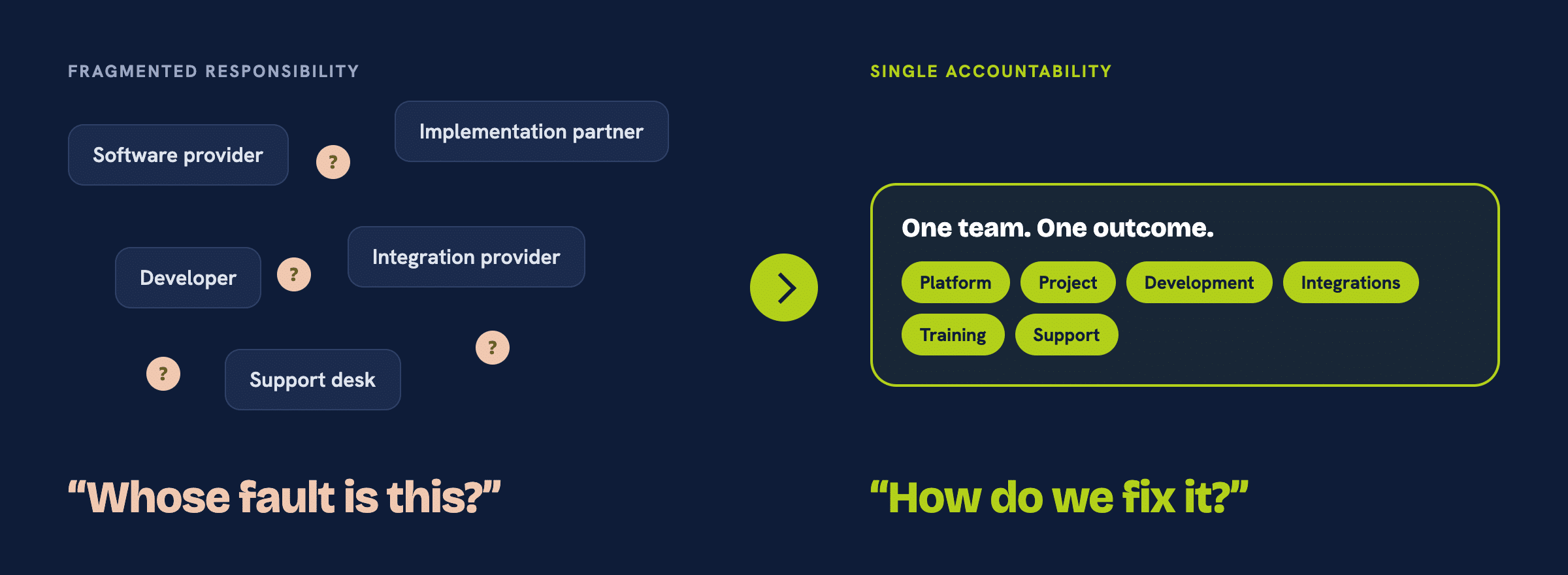
From “Whose Fault Is This?” to “How Do We Fix It?”
Features can be compared in a spreadsheet. Pricing can be modelled over three years. Accountability is harder to measure up front — which, as we said at the start, is exactly why it gets overlooked until the first time it’s needed.
“Whose fault is this?”
“How do we fix it?”
That change in conversation is the real value of accountability. It doesn’t show up in a demo, but it shows up in every problem you’ll have over the lifetime of your system — and in how quickly each one goes away.
Ultimately, choosing a CRM supplier is choosing who you’ll trust when something unexpected happens. It’s worth knowing the answer before you need it.
Whatever you choose, ask the questions above. The answers will tell you a great deal about what the next five years will feel like. And if you’re weighing up options now, you can compare OpenCRM with other CRM approaches.
Frequently Asked Questions
What is single-supplier accountability in a CRM project?
It means one organisation is responsible for the whole outcome — discovery, scoping, configuration, development, integrations, training and ongoing support — rather than those responsibilities being split between a software provider, an implementation partner, developers and a separate support desk. When something goes wrong, there is one place to go and one team that owns the fix.
Is it risky to buy CRM from a smaller supplier?
Size alone is not a reliable measure of risk. Larger suppliers bring scale, but responsibility is often spread across departments, partners and escalation paths. Smaller specialist suppliers can offer continuity and direct accountability. The better questions are how long the supplier has been trading, who owns the business, how knowledge is shared across the team, and how your data is protected and exportable.
Why do CRM projects involve so many different suppliers?
Many CRM platforms are built by a software provider and sold and implemented through a network of partners. Customisation, integrations and support can each be handled by different organisations. That model can work well, particularly for very large or highly specialised projects, but it creates handovers between suppliers where responsibility can become unclear.
What should I ask a CRM supplier about accountability?
Ask who you call when something breaks, who owns the integrations, who wrote any custom development and who will support it, whether the people who scoped the project will still be involved after go-live, and what happens if the problem sits between two suppliers. Clear, specific answers to those questions tell you more than most feature comparisons.
Does a single supplier mean less choice?
Not necessarily. A single accountable supplier can still integrate with the other systems you use, such as accounting, email and telephony. The difference is that one organisation takes responsibility for how those pieces work together, rather than each supplier only being responsible for its own part.

One team. One point of contact. One organisation accountable.
Book a Discovery call and ask us the questions above — we’re happy to be tested on them.
Book Discovery call